US President Donald Trump has proposed NATO allies impose sweeping 50-100% tariffs on China until the Russia-Ukraine war ends, aiming to cut Beijing’s economic support for Moscow. The move highlights Trump’s trade-war strategy, NATO’s oil dependence, and global risks including supply chain disruptions, legal hurdles, and potential retaliation from China and India.
Trump Calls for 50-100% NATO Tariffs on China
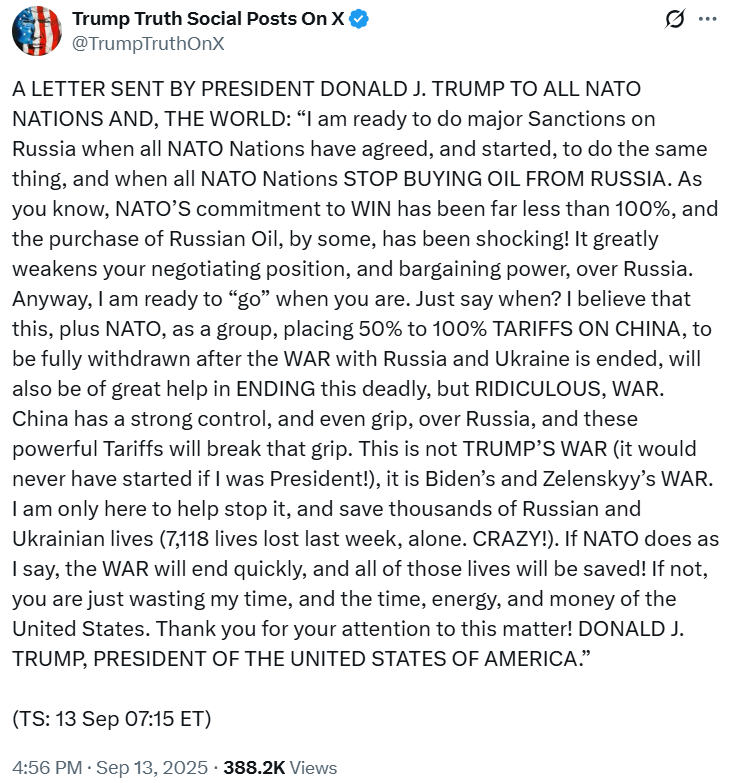
In a dramatic escalation of economic pressure strategies tied to the Russia-Ukraine conflict, U.S. President Donald Trump has urged NATO allies to impose sweeping tariffs of 50 to 100 percent on Chinese imports until the war concludes. The proposal, unveiled in an open letter posted on Trump’s Truth Social account, is designed to cut China’s economic ties with Russia and disrupt Moscow’s wartime revenue streams. With the conflict now entering its fourth year and marked by recent surges in violence, Trump’s plan signals his intention to weaponize trade at a global scale.
Trump’s message to NATO members was direct. He called on all allies to stop purchasing Russian oil, impose major sanctions on Moscow, and most significantly, implement high tariffs on China. According to Trump, Beijing’s role as Russia’s largest energy buyer enables Moscow to sustain its war efforts. “China has a strong control, and even grip, over Russia, and these powerful Tariffs will break that grip,” Trump wrote. He added that the tariffs should remain in force until the war between Russia and Ukraine is fully over, after which they would be lifted.
This is not Trump’s first attempt to use trade as leverage in the conflict. Earlier this month, he urged the European Union to impose similar tariffs of up to 100 percent on both China and India, another major buyer of discounted Russian oil. He made this demand during a call with EU sanctions envoy David O’Sullivan, emphasizing that the United States would only commit to such measures if Europe participated as well.
Last month, Washington had already increased tariffs on Indian goods to 50 percent, citing New Delhi’s continued purchases of Russian crude. This move strained U.S.-India relations, despite Trump’s continued outreach to Indian Prime Minister Narendra Modi.
The political framing of this proposal is also important. Trump continues to place responsibility for the war on his predecessor Joe Biden and Ukrainian President Volodymyr Zelenskyy. He calls it “Biden’s and Zelenskyy’s war” and claims it would never have started under his leadership. According to Trump, over 7,000 lives were lost just in the past week, a figure he cites to underscore the urgency of his strategy. He positions himself as a potential peacemaker, promising to save thousands of lives in both Russia and Ukraine.
Trump’s focus on China is not accidental. Since the invasion in 2022, Beijing has emerged as Russia’s top trading partner and lifeline. Imports of discounted Russian oil and gas have surged, with estimates suggesting China and India together accounted for more than 100 billion dollars in energy purchases last year.
This has allowed Moscow to evade Western sanctions and keep its economy stable despite military costs. NATO’s own mixed record adds another layer of complexity. Turkey remains the alliance’s third-largest buyer of Russian oil, while Hungary and Slovakia continue limited imports. Trump argues this lack of unity has weakened the alliance’s leverage over President Vladimir Putin.
The tariff proposal aligns with Trump’s long-standing “America First” trade philosophy, which uses tariffs as a blunt tool to force change. But such a sweeping measure risks serious global fallout. China has already rejected the idea as economic coercion. Experts warn that Beijing could retaliate with its own tariffs or by accelerating efforts to de-dollarize trade.
This could disrupt global supply chains, raise consumer prices, and trigger further instability in markets. India, already under pressure from recent U.S. tariffs, has been cautious in responding. While New Delhi emphasizes its policy of strategic autonomy, it has also deepened ties with Russia and China through forums like the Shanghai Cooperation Organisation.
Meanwhile, Russia has shown no signs of backing down. Last week, Moscow launched its largest aerial assault on Ukraine since the war began, including missile strikes on government buildings in Kyiv. Polish forces intercepted Russian drones over NATO airspace, highlighting the growing risk of escalation. Trump, who has promised to end the war on his first day in office, has attempted diplomacy with Putin, including a recent but unsuccessful summit in Alaska. He reportedly plans further talks soon.
Reactions to Trump’s plan have been mixed. Within NATO and the EU, officials remain cautious. European leaders generally prefer targeted sanctions on Russia over broad tariffs that could hurt their own economies, especially since Russia provided 19 percent of the EU’s gas supply before the war. In Washington, a bill backed by 85 senators would allow secondary tariffs on countries trading with Russia, but legal questions remain.
A U.S. trade court recently ruled that Trump’s broad tariff powers exceed presidential authority, a decision now before the Supreme Court. If upheld, it could force the government to refund billions of dollars in collected tariffs. Economists also warn that new tariffs would raise global prices and push countries like India further toward Russia and China.
Public reaction has been sharp online. On X, formerly Twitter, users like @RealJakeBroe criticized the idea as counterproductive for alienating India, while others like @DeItaone pointed out Trump’s strategy of pushing Europe to take the lead against China. Media outlets amplified the debate, and analysts speculated on potential volatility in stock and cryptocurrency markets if such tariffs were introduced.
The implications of this proposal are vast. If NATO were to follow Trump’s lead, it would mark an unprecedented collective move against China, escalating not only the Russia-Ukraine conflict but also the ongoing U.S.-China trade war. It could strengthen the BRICS bloc as Russia, China, and India move closer in response. Some countries may even follow Mexico’s recent example, where tariffs on Chinese automobiles were raised to 50 percent to protect domestic industries.
Ultimately, Trump’s proposal reflects his belief that economic pressure is the fastest way to end the war. Whether tariffs of this magnitude could achieve that goal or instead ignite new global trade conflicts remains uncertain. As one EU official commented anonymously, “If you do not get at the source of the money, there’s no way to stop the war machine.” For Trump, the source of that money lies in Beijing’s support for Moscow. For NATO and the rest of the world, the question is whether they are prepared to take that gamble.
Disclaimer:
This article is based on publicly available reports, political statements, and expert commentary. It is intended for informational and analytical purposes only and should not be construed as financial, investment, or legal advice. The views and statements attributed to political leaders and governments are their own and do not reflect the views of this publication. Readers are encouraged to cross-check information with official sources before drawing conclusions.