

Prime Minister Keir Starmer begins the UK’s largest-ever trade mission to India, joined by 125 CEOs, entrepreneurs, and cultural leaders. The visit builds on the landmark UK-India trade deal signed in July, aiming to boost trade, create jobs, and strengthen cooperation across business, education, and technology sectors.
UK Prime Minister Keir Starmer Leads Historic Trade Mission to India
In a major diplomatic and economic move, Prime Minister Keir Starmer has embarked on a landmark two-day trade mission to India, accompanied by 125 of the UK’s most prominent CEOs, entrepreneurs, university Vice Chancellors, and cultural leaders. The mission, focused on expanding trade, creating jobs, and strengthening bilateral relations, marks the largest ever government-led business delegation to India.
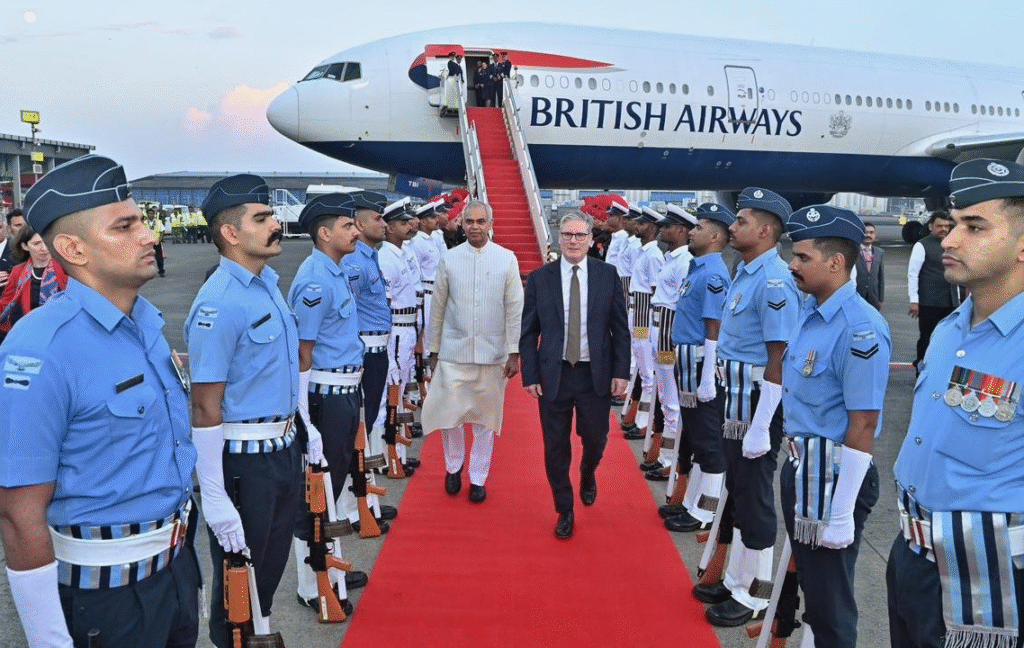
The visit follows the historic UK-India trade deal signed in July, which is expected to lower tariffs, unlock market access, and accelerate economic growth for both nations. Under the agreement, India’s average tariff on UK products will fall from 15% to 3%, making it easier for British companies to export goods ranging from cosmetics and soft drinks to cars and medical devices.
According to government estimates, the trade deal is projected to increase the UK’s GDP by £4.8 billion annually, raise wages by £2.2 billion, and boost bilateral trade by £25.5 billion per year. UK exports to India are expected to rise by nearly 60%, benefitting industries across the country.
Major British corporations such as Rolls-Royce, British Telecom, Diageo, London Stock Exchange Group, and British Airways are part of the Prime Minister’s delegation. They aim to strengthen their foothold in one of the world’s fastest-growing economies while driving domestic job creation and investment opportunities.
Prime Minister Starmer emphasized that the mission is not just symbolic but a tangible step toward economic transformation. “We signed a major trade deal with India in July – the best secured by any country – but the story doesn’t stop there. It’s a launchpad for growth. With India set to be the third biggest economy in the world by 2028, the opportunities waiting to be seized are unparalleled,” he said.
The mission also highlights the participation of small and medium enterprises (SMEs) from across the UK. These businesses stand to benefit from improved customs procedures, digital trade facilitation, and dedicated support services that will simplify access to the Indian market. Many of these SMEs are expected to form new partnerships and establish a stronger global presence.
Business and Trade Secretary Peter Kyle praised the progress made in strengthening UK-India relations. “Our deal is the best any country has ever secured with India and places British businesses at the front of the queue to access a huge and ever-growing market. We are using every means necessary to prepare businesses to take full advantage of the massive opportunities once the deal comes into force,” he said.
The trade mission coincides with new announcements from key British companies. British Airways confirmed plans to introduce a third daily flight between Delhi and London Heathrow by 2026, further expanding connectivity between the two nations. The airline’s CEO, Sean Doyle, stated, “The Free Trade Agreement with India will boost economic momentum between our two countries. British Airways sits at the centre of that activity, helping to enable trade, travel, and economic exchange.”
Manchester Airport also announced a new direct route to Delhi, operated by IndiGo, adding to its existing Mumbai service. This expansion makes it the only UK airport outside London with connections to both major Indian cities. The development is expected to generate over £50 million in annual exports, £25 million in tourism revenue, and create 450 new jobs in the region.
The trade mission’s delegation also includes 14 university Vice Chancellors, highlighting the growing demand for higher education in India. With 70 million new student places needed by 2035, the visit aims to foster educational collaborations, research partnerships, and exchange programs.
Cultural exchange is another key element of the visit, with institutions such as the British Film Institute and the National Theatre participating to explore opportunities in film, fashion, digital culture, and heritage collaborations. These partnerships are expected to pave the way for co-productions and creative exports that further deepen UK-India ties.
The visit follows Indian Prime Minister Narendra Modi’s trip to the UK in July, during which nearly £6 billion in new investments and export deals were announced, creating over 2,200 jobs in the UK.
Tufan Erginbilgic, CEO of Rolls-Royce, highlighted the mutual benefits of the partnership, stating, “The UK and India are natural partners, working in a win-win collaboration. Our engineering and technological capabilities position us as a strategic partner to India in aviation, defence, infrastructure, and energy security.”
During the two-day visit, Prime Minister Starmer will also meet Prime Minister Modi to further strengthen cooperation under the Technology Security Initiative. The two leaders are expected to discuss expanding collaboration in artificial intelligence, telecommunications, and defence technology — sectors poised to define the next phase of global economic growth.
India’s technology sector, projected to reach a valuation of £1 trillion by 2030, represents a crucial pillar of this partnership. The UK government sees the sector as a major driver of innovation and investment, offering vast opportunities for British firms to participate in India’s digital transformation.
With this trade mission, the UK aims to cement its position as one of India’s closest economic partners, creating a foundation for sustainable growth, innovation, and mutual prosperity.
Disclaimer:
This article is based on official government releases and statements by participating business and government leaders. Figures and projections are subject to future revisions based on economic conditions and trade implementation outcomes.