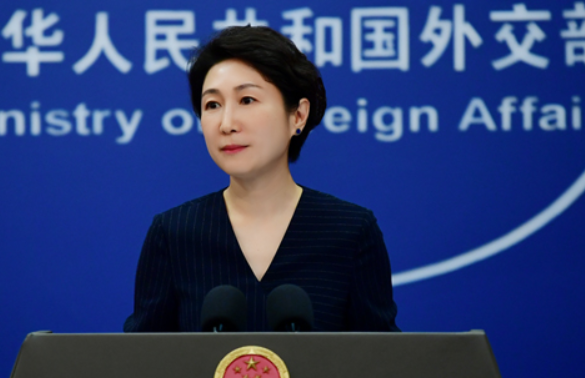
China Foreign Ministry spokesperson Mao Ning addressed key global developments during the July 9, 2025, press conference. Topics included the UN Human Rights Council’s adoption of a China-led resolution emphasizing development and human rights, Beijing’s response to EU Commission President Ursula von der Leyen’s remarks on trade distortions and overcapacity, and rising tensions over Taiwan’s U.S.-backed military drills.
Mao also commented on U.S. restrictions on Chinese farmland purchases, the alleged laser targeting of a German aircraft by Chinese forces, and growing public support for China across Latin America. With crucial China-EU and China-U.S. summits approaching, the press briefing offers deep insights into China’s foreign policy, economic diplomacy, and strategic narratives in 2025.
China July 9, 2025, Foreign Ministry Briefing: UN Human Rights Win, EU Trade Tensions, and Taiwan
At the July 9, 2025 regular press conference by China’s Foreign Ministry Spokesperson Mao Ning, a wide array of global diplomatic, economic, and security issues were addressed. From the adoption of a China-proposed resolution at the United Nations Human Rights Council to escalating trade tensions with the EU and U.S., Mao provided comprehensive responses that reflected Beijing’s evolving foreign policy stance and strategic posture. Below is a detailed summary of all the key issues discussed during the press briefing:
China July 9, 2025, Foreign Ministry Briefing:UN Human Rights Council Adopts China-Proposed Resolution
Mao Ning opened the conference with a significant announcement: the 59th session of the UN Human Rights Council in Geneva had adopted China’s resolution titled “The contribution of development to the enjoyment of all human rights.” The resolution, passed by consensus, underlined the importance of high-quality development with a people-centered approach to fulfill human rights. Mao stressed that development and human rights are central to the UN’s mission, and China is committed to working with all countries in upholding multilateralism and promoting inclusive development.
China July 9, 2025, Foreign Ministry Briefing: China-Russia Ties Under European Scrutiny
When asked about European Commission President Ursula von der Leyen’s remarks that included requests for China to limit its cooperation with Russia, Mao emphasized that China-Russia cooperation is independent, not directed at any third party, and should not be disrupted by any external force.

China July 9, 2025, Foreign Ministry Briefing:Trump’s Positive Remarks on Trade with China
In response to U.S. President Donald Trump’s recent comments claiming improved U.S.-China relations and fairness in trade dealings, Mao responded diplomatically, reiterating China’s policy of mutual respect, peaceful coexistence, and mutually beneficial cooperation in managing its relationship with Washington.
China July 9, 2025, Foreign Ministry Briefing:China at the Osaka Expo
On the question of China’s participation in the upcoming National Pavilion Day at the Osaka Expo on July 11, Mao stated that a delegation will attend, and further details would be released in due time.
China July 9, 2025, Foreign Ministry Briefing:Laser Incident Allegation by Germany
Germany had recently alleged that the Chinese military used a laser against a German aircraft in the Red Sea, prompting Berlin to summon the Chinese ambassador. Mao responded by asserting that China’s information does not align with Germany’s claims. She noted that China’s naval missions in the Gulf of Aden and off Somalia are part of its international responsibilities to safeguard global shipping lanes, and stressed the need for accurate, timely communication to prevent misunderstandings.
China July 9, 2025, Foreign Ministry Briefing:Positive Sentiment in Latin America Towards China
A survey by LatAm Pulse, conducted by AtlasIntel and Bloomberg, found that public opinion toward China is improving in six major Latin American economies: Brazil, Mexico, Argentina, Colombia, Chile, and Peru. Mao highlighted that this is due to China’s significant role in regional trade, infrastructure investment, and development financing. She referred to President Xi Jinping’s vision of a China-Latin America community with a shared future, founded on equality, mutual benefit, and openness.
China July 9, 2025, Foreign Ministry Briefing:Taiwan’s Military Drills and U.S. Arms Support
Taiwan began its annual military drills on July 9, featuring newly acquired U.S. high-tech rocket systems. Taiwan’s defense authorities claimed the drills were to demonstrate their resolve in protecting their “sovereignty” and “democratic lifestyle.” Mao responded by reaffirming China’s firm opposition to any form of military ties between the U.S. and Taiwan. She reiterated that efforts by Taiwan’s ruling Democratic Progressive Party (DPP) to seek “independence” through foreign military support are destined to fail.
China July 9, 2025, Foreign Ministry Briefing:U.S. Farmland Purchase Ban for Chinese Nationals
In a fresh development, the U.S. government announced restrictions on farmland purchases by Chinese nationals and others deemed “foreign adversaries,” citing national security. Mao criticized this move as discriminatory, saying it violated market economy principles and international trade rules. She urged Washington to stop politicizing trade and investment matters.
EU Accusations on Trade Imbalance and Market Access
European Commission President von der Leyen recently accused China of distorting trade, exporting industrial overcapacity, and limiting access for European companies. These comments came just two weeks before a planned China-EU summit. Mao acknowledged that while the EU recognized China’s achievements in green development and poverty alleviation, it continues to voice concerns over trade imbalances.
Mao firmly responded to the EU’s demands by explaining that China-EU trade relations have matured over five decades and are driven by structural and macroeconomic factors, not unilateral decisions. She called for fair, reciprocal engagement rather than distortion of facts or double standards. Mao noted that subsidies exist in both regions, with the EU itself planning to distribute over €1.44 trillion in subsidies by 2030.
She also challenged the overcapacity argument by asking whether Airbus jets or German automobiles should be similarly labeled. Mao emphasized the need for the EU to adopt a more balanced mindset and focus on constructive cooperation rather than amplifying disputes.
Conclusion: A Call for Balanced Dialogue Amid Global Tensions
Mao Ning’s remarks throughout the briefing underline China’s current diplomatic narrative: advocating multilateralism, opposing unilateral restrictions, and calling for fair trade practices. As the world navigates an increasingly complex geopolitical environment—marked by disputes over Taiwan, strategic alignments with Russia, and intensifying EU-China trade competition—Beijing appears intent on defending its policies while appealing for dialogue and cooperation.
With major summits and high-level engagements scheduled in the months ahead, including the China-EU summit and growing engagement with Latin America and Africa, China’s foreign policy appears to be focused on diversifying its diplomatic relationships while managing friction points with established powers like the U.S. and EU.